


Automation is not always the same
Automating tightening processes in industrial manufacturing goes far beyond simply using robots: It represents intelligent systems which deliver precise and reliable tightening to ensure quality and productivity. This enables manufacturers to effectively address key challenges such as labor shortages, high safety requirements, increasing quality demands and growing product diversity.
Not every automation solution is suitable for every production environment – selecting the appropriate degree of automation is the key for success.
Why is automation important?

Compensation of labor shortages
Automated tightening systems relieve employees and maintain production capability despite labor shortages.

Improvement of workplace safety
Manual tightening process could be the reason for ergonomic strain of the operators. Automation provides sustainable relief.

Management of product mix & variants
Flexible systems enable quick changeovers and customization, supporting shorter cycle times despite high product diversity.

Overcoming system complexity
As technical complexity increases, so does the need for intelligent, integrated automation concepts.

Ensuring quality from the beginning
Every tightening should be correct. Automated systems with integrated quality control ensure error-free processes and reduce scrap.

More sustainable manufacturing
Correct tightening processes reduce scrap and material losses to minimize resource consumption and supporting environmental goals.
Semi or fully automated tightening: What automation solutions are available in industrial tightening technology?
Automation in tightening is variable – the correct solution depends on your specific production requirements. We distinguish two main approaches: semi automation and full automation. The following overview explains how both concepts work in automated manufacturing, provides product examples, and outlines their benefits.

Semi automated tightening
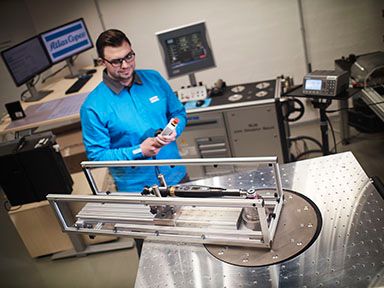
Humans and machines could work together. The operator uses a handheld tightening module, while the screw is automatically provided by a step feeder.
Benefits:
- Consistent and repeatable tightening based on automated feeding components
- Operator relief with flexibility for manual intervention
- Ideal for production with different tightenings and product variants
- Precise feeding prevents material loss and reduces rework

Fully automated tightening
From screw feeding and positioning to the actual tightening and final quality control – every step is fully automated, for example by a turnkey tightening cell integrated into the production line.
Benefits:
- Maximum process reliability by fully automated tightenings
- Ideal for high number of tightenings and standardized processes – reduces cycle times and increases throughput
- Full integration into digitalized production systems for complete process documentation
- Perfect for high-volume series production with advanced automation
- Tightening cells can be integrated inline or as a stand-alone solution
Where is the bottleneck in your assembly processes?
Whether semi or full automation is the right choice depends on your specific production needs. Ask yourself:
Which tightening applications or components are most critical in your production – regarding quality, time, or ergonomics?
Your answer decides:
- Station-level automation – ideal for resolving specific bottlenecks while maintaining flexibility
- Line-level automation – suitable for systemic challenges
Recommendation: Not every tightening is equally relevant for throughput or product quality. Focus on key processes to achieve the best result.

Resolve bottlenecks with automation solutions for tightening
Once you’ve identified the biggest bottleneck of your tightening processes, new opportunities could open up to optimize your production. Automation isn’t just a solution for today – it’s a strategic lever for the future.
Your vision can become reality:
- Digital transformation: Connected systems for full transparency and traceability.
- Zero-defect strategy: Quality assurance at the highest level.
- First-time-right: Every tightening is correct with no rework required.
- Measurable ROI: Investments in automation pay off quickly by shorter cycle times, lower scrap rates, and optimized operating costs.
- Efficiency and scalability: Processes which grow with your business.
With over 150 years of experience in industrial assembly, Atlas Copco is your trusted partner for the automation of tightening processes. Our solutions integrate seamlessly into existing production lines from semi automated stations to fully automated systems.
Your vision. Our expertise. Together towards perfect assembly.
Our semi-automated and fully automated tightening systems
Workstations with automated tightening processes: Our solutions combine the best of both worlds – human expertise and robotics.


Our fully automated tightening systems integrate seamlessly into your production line, ensuring quality speed, and process reliability – even for the most complex requirements.


Thanks to our scalable, modular platform, the systems adapt flexibly to your specific requirements and process conditions. As a result, you get a solution that boosts efficiency, ensures quality, and makes your production future-ready.
Industrial companies worldwide trust the easy operability of our technologies.
FAQs:
How can I automate my tightening processes?
The automation of tightening processes takes place in several steps: First, an analysis is conducted to determine which work steps are suitable for automation – these can be individual stations or entire production lines. Next, suitable technologies such as fixtured nutrunners, control systems, and screw feeding systems are integrated. Depending on the requirements, these solutions can be combined with robots.
What added value does the automation of tightening processes offer?
Automated tightening processes increase productivity, reduce error rates, and improve ergonomics for your personnel. You benefit from shorter cycle times, higher process reliability, and complete data traceability for quality assurance and Industry 4.0 requirements.
Do I need to fully automate right away?
Depending on your production setup and assembly bottlenecks, you can choose between targeted automation at a single station or full-scale automation of multiple tightening processes – to cut costs, improve ergonomics, and boost quality.
What advantages do Atlas Copco solutions offer compared to other systems on the market?
Atlas Copco delivers everything from a single source – from tightening technology and control systems to full process integration. We provide turnkey solutions, take complete process responsibility, and ensure seamless integration into existing production lines. With open interfaces, robot arms from any manufacturer can be easily connected.
Which screw types are covered by Atlas Copcos screw feeding system?
Our screw feeding system handles screw types from M2 to M24 and lengths up to 150 mm, making it ideal for a wide range of industrial screwdriving applications.
