



Calibration standards provide the framework for ensuring production tools and quality assurance equipment deliver accurate and reliable results. They define how calibration should be performed, which requirements must be met, and ensure traceability of results. For production and quality managers, understanding these standards is key to maintaining consistency, meeting customer expectations, and complying with industry regulations. This guide breaks down the essentials, highlighting the most relevant calibration standards in tightening technology and their role in securing quality and traceability in modern manufacturing.
What are calibration standards?
Calibration standards are formal, documented requirements that define how tools and equipment should be calibrated to ensure they deliver accurate and consistent results. In many cases, these requirements are part of broader quality management standards. For example, ISO 9001 focuses on consistent quality, where calibration is one of the key elements. It is critical to adhere to calibration standards and to demonstrate compliance through proper documentation. It directly impacts safety, the ability to prove product quality, and even the legal right to trade in some cases.
Equipment calibrated against recognized standards ensures trustworthy results since the calibration is carried out by qualified personnel under specified, reproducible, and controlled conditions. This can only be assured by mandating accredited calibration providers. For instance, the ISO/IEC 17025 standard states that calibration work shall be performed in a laboratory that has been officially accredited to a relevant standard for the desired purpose. This ensures that results are not only accurate but also traceable to national or international standards, creating confidence across industries and beyond any borders.
* ISO: International Organization for Standardization
* IEC: International Electrotechnical Commission
💡Calibration: Using a defined measurement system, two values are compared with each other: the value given by the device to be calibrated and the value given by the reference. The calibration process documents this deviation and allows a suitable adjustment of the equipment.
Why do we need calibration standards?
Calibration standards exist to ensure that measurements can be trusted, no matter where calibration is performed. Over time, tools and measuring equipment inevitably drift from their original accuracy due to wear, environmental factors, and use. Without standards, there would be no reliable way to verify or correct this drift, and no guarantee that a measurement in one facility is reproducible elsewhere.

Common calibration standards
1. Calibration lab requirements
Calibration laboratories shall operate under certain standards to ensure the accuracy, reliability, and traceability of their measurements. ISO/IEC 17025 is the internationally recognized standard that defines the competence and quality requirements for calibration laboratories. Achieving accreditation to this standard demonstrates that a lab meets the highest competence, rigorous technical and management criteria, providing confidence in the results it produces.
In the automotive sector, the IATF 16949 standard specifies that calibration shall, whenever possible, be conducted by an ISO/IEC 17025 accredited laboratory. Compliance with this standard ensures that suppliers meet industry expectations, maintain product quality, and support consistent, traceable measurements across the supply chain.
* IATF: International Automotive Task Force
2. Tool calibration standards
Apart from calibration lab requirements, there are also several standards for tool calibration. ISO 6789-2 is an accredited calibration for torque wrenches used in production, including electronic, dial, and click type of wrenches. ISO 5393 is a crucial international standard for the industrial assembly sector, specifying a test method for evaluating the performance of power assembly tools used to tighten threaded fasteners. It applies to tools that apply torque in a continuous manner, of any power source (such as pneumatic or electric, including battery-powered). By using controlled test methods and procedures, ISO 5393 allows manufacturers and users to assess a tool's accuracy and reliability, ensuring product quality and supporting overall process control in manufacturing environments.
In some markets, where the definition of accredited tool calibration differs, calibration service providers may conduct an accredited machine capability test (MCT) according to the VDI/VDE 2645–2 standard. This is a German standard that outlines the procedures for conducting MCT for power assembly tools, particularly those used in industrial fastening. This standard is unique because it not only describes how to conduct machine capability tests in general but also specifies how they can be done for a specific production application. Consequently, the MCT for a tool can be conducted for one of the two aspects, either certifying the entire tool or certifying the tool only for a specific application. In addition to torque, this particular standard also covers the application of angle, providing a comprehensive assessment of tool performance.
* VDI: The Association of German Engineers
* VDE: The Association for Electrical, Electronic & Information Technologies
3. Quality assurance calibration standards
Calibration of quality assurance equipment must also comply with several well-established industry norms and standards. EURAMET/cg-14 is the widely adopted standard for accredited calibration for torque transducers used for quality control. For accredited quality assurance calibrations, most markets apply national standards that are often based on this procedure. The German DIN 51309 and the British BS 7882 are two widely used standards basing on EURAMET/cg-14.
In addition, the VDI/VDE 2648-1 and VDI/VDE 2648-2 for calibration of angle of quality assurance equipment is widely used. It is originally a German standard but has been used globally since no international equivalent currently exist. Together, these standards ensure reliable, traceable, and consistent performance of quality assurance equipment across industries, giving manufacturers confidence that their fastening processes meet the highest accuracy requirements.
* EURAMET: The European Association of National Metrology Institutes
Atlas Copco calibration services: Securing quality, safety, and reliability
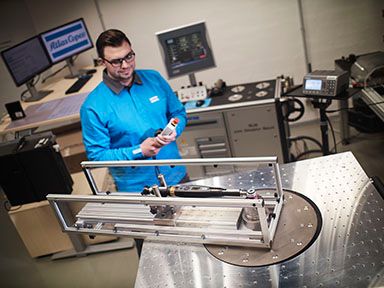
To ensure safety, performance, and consistent quality in production, tool and quality assurance equipment calibration is essential. At Atlas Copco, calibrations are carried out by experts using traceable equipment fully in accordance with ISO/IEC 17025 requirements. Whether performed in a lab, in the field, or directly at customer site, the process starts with inspection, a functional test, and for tools also with motor tuning, to secure optimal performance. The tools and quality assurance equipment will be optimized and adjusted for the best performance. Finally, a calibration certificate is issued according to the national standards, with records stored for at least 10 years. With Atlas Copco calibration services, you not only gain compliance but also secure reliable tools and measuring equipment, minimize risk, and achieve complete peace of mind.
Additional resources
- Calibration Leaflet 305.3 kB, PDF
- Tool Calibration Leaflet 2.7 MB, PDF
- Quality Assurance Calibration Leaflet 339.9 kB, PDF
- Pocket Guide Calibration and testing of tightening systems 17.3 MB, PDF


