
View all our industries

Our industries

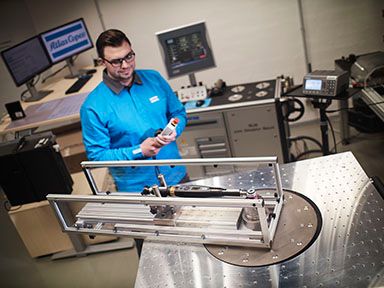
Time to calibrate?

Secure your quality and reduce defects through Tool Calibration and Accredited Quality Assurance Calibration.​
power tool calibration, tool testing, metrology, machine capability test

Momentum Talks

Discover inspirational and engaging talks on Atlas Copco
Momentum Talks
Close
Expert Insight

Augmented Reality Projection: A Game-Changer for Measurement Technicians in Steel Construction

2 minute(s) to read July 22, 2025

Precision in Steel Construction

Measurement technician at work

Precision is essential in every measurement a technician makes.

Steel construction is a field that requires precision to meet its time- and resources-critical nature. Measurement technicians play a critical role in ensuring that steel parts, assemblies, and attachments meet stringent specifications. A particular difficulty that they face is to compare the actual and target state of parts or assemblies and attachments in between subsequent steps in the welding process. This is the only way to ensure that later welding steps can be carried out in sync with previous steps despite certain local deviations in the base structure that may have accumulated during previous steps, and thus to ensure that the whole part can be manufactured within the specified tolerances.

To address these issues, augmented reality projection (AR projection)—particularly dynamic laser projection systems—offers a transformative solution. By streamlining measurement workflows, AR projection not only enhances accuracy but also significantly reduces manual effort, paving the way for smarter, faster, and more cost-effective steel construction.

The Burden on Measurement Technicians

Measurement technicians face several core challenges that require not only technical expertise but also significant time and physical effort, making the role demanding and resource-intensive.

Heat Distortion
Heat Distortion
Welding processes often deform steel components resulting to prolonged production process. This requires technicians to assess and correct these distortions down the line.
 
Welding processes often deform steel components resulting to prolonged production process. This requires technicians to assess and correct these distortions down the line.
Tolerance Management
According to standards like ISO/TC 213 and ASME Y14.5, different parts require varying levels of precision. Critical components demand tighter tolerances and must be manufactured more precisely.
 
According to standards like ISO/TC 213 and ASME Y14.5, different parts require varying levels of precision. Critical components demand tighter tolerances and must be manufactured more precisely.
Target-actual-comparison
Based tactile or photogrammetric measurements, technicians must manually compare the actual state of components with CAD models or design specifications to identify discrepancies.
 
Based tactile or photogrammetric measurements, technicians must manually compare the actual state of components with CAD models or design specifications to identify discrepancies.
Interruptions
Interruptions
Measurement processes often halt other production activities, leading to inefficiencies and delays.
 
Measurement processes often halt other production activities, leading to inefficiencies and delays.
Rework
Rework
Misalignments or inaccuracies can result in costly rework, such as grinding, milling, or welding additional material.
 
Misalignments or inaccuracies can result in costly rework, such as grinding, milling, or welding additional material.

Putting Innovation on the table: Augmented Reality Projection (AR projection)

What is AR Projection?

AR projection in steel construction involves using laser projectors, cameras, and intelligent software to overlay digital information directly onto physical components. This allows technicians to visualize target positions, alignments, and work instructions in real-time, without manual marking or referencing paper plans.

How it Works

The system typically includes:

  • Laser Projector: Projects precise visual guides onto the steel surface.
  • Cameras: Detect reference markers or other features on the component to orient the projection accurately.
  • Software: Imports measurement data and CAD models to generate projection instructions.

By recognizing 3–4 reference markers already used in prior measurements, the system aligns the projection with the physical part, ensuring high spatial accuracy.

IPG Welding Application Campaign

Industrial Projection Guidance (IPG)

EXTEND3D, part of the Atlas Copco Group, offers the Industrial Projection Guidance (IPG) a dynamic laser projection system tailored for steel construction.

Key features

Time and Effort Reduction
IPG can reduce manual effort by up to 75%. Instead of manually marking coordinates or interpreting complex drawings, technicians can rely on laser-guided visuals to position attachments and verify alignments instantly.
 
IPG can reduce manual effort by up to 75%. Instead of manually marking coordinates or interpreting complex drawings, technicians can rely on laser-guided visuals to position attachments and verify alignments instantly.
Increased Accuracy
Increased Accuracy
The system minimizes human error by directly projecting the target state onto the actual component. This ensures that parts are placed and adjusted with high precision, reducing the likelihood of rework.
 
The system minimizes human error by directly projecting the target state onto the actual component. This ensures that parts are placed and adjusted with high precision, reducing the likelihood of rework.
Seamless Integration with Existing Methods of Target-Actual-Comparison
IPG enhances both tactile and optical measurement methods—like CMMs, photogrammetry, and laser trackers—by integrating seamlessly to improve accuracy and efficiency without replacing them.
 
IPG enhances both tactile and optical measurement methods—like CMMs, photogrammetry, and laser trackers—by integrating seamlessly to improve accuracy and efficiency without replacing them.
Continuous Workflow
Continuous Workflow
Unlike manual measurement, IPG enables real-time collaboration, minimizing downtime and speeding up production.
 
Unlike manual measurement, IPG enables real-time collaboration, minimizing downtime and speeding up production.
Workforce Optimization
By automating routine tasks, IPG lets technicians focus on higher-value work—improving job satisfaction and addressing skilled labor shortages.
 
By automating routine tasks, IPG lets technicians focus on higher-value work—improving job satisfaction and addressing skilled labor shortages.

Conclusion: A Step Toward Industry 5.0

The IPG as an AR projector is more than a productivity tool—it represents a shift toward Industry 5.0, where human expertise and digital technologies work in harmony. By optimizing processes that are difficult to automate, the IPG empowers technicians to deliver better results with less effort.

For steel construction companies, adopting IPG projection means:

  • Embracing innovation.
  • Enhancing workforce capabilities.
  • Staying competitive in a demanding market.

As the industry evolves, innovations like IPG will become essential for maintaining quality, efficiency, and agility in steel construction.

Industrial Projection Guidance
IPG-L Mobile
Industrial Projection Guidance
IPG Mobile in Digital Template Work
ITER Welding Application
IPG Mobile in Digital Template Work