
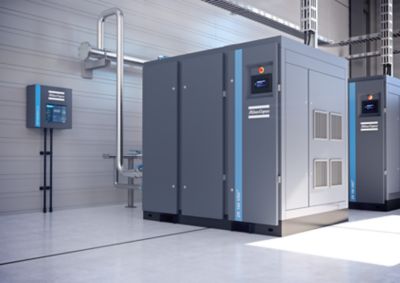

Spoiler alert: Wrong. Multiple VSD compressors offer clear advantages over mixed VSD/fixed-speed installations – not just in energy savings, but also in system stability, cost-efficiency, and long-term maintainability.
Fact: All-VSD compressor rooms outperform mixed setups
Traditional thinking suggests one fixed-speed compressor to cover base load efficiency, with a VSD unit to handle fluctuations. That setup still works – but it’s no longer the optimal option. Today’s VSD compressors are efficient enough at full load that a full-VSD setup is the better choice.


A recent engineering analysis showed that an all-VSD configuration delivers the lowest Total Specific Energy Requirement (SER) – even under high demand. Because both (or all) units can modulate speed, they avoid the pressure imbalance and energy waste that fixed-speed machines create when switching on and off.
Fact: Full-VSD systems eliminate the regulation gap
In mixed setups, fixed-speed compressors deliver a fixed flow that often doesn’t match the exact demand. This creates a 'regulation gap' – a mismatch that forces VSDs to run inefficiently at low speeds or leads to over pressurization.
Multiple VSD eliminate this issue. Every unit can ramp up or down to deliver exactly the required flow, without the stop-start losses or oversizing common in fixed-speed systems. And unlike in mixed rooms, there’s no need to oversize the VSD to compensate for the fixed-speed compressor’s rigidity.
Fact: VSD-only compressor rooms reduce total cost of ownership
Running costs aren’t just about energy – although multiple VSD significantly lower that too. By using identical compressors, you also simplify maintenance, training, and spare parts inventory.
- Fewer training hours for technicians
- One maintenance routine instead of many
- Lower inventory burden (same spares across the board)
VSD share running hours more evenly too. In a mixed system, the VSD often runs constantly while the FS machine idles. This leads to faster wear and higher service costs. With multiple VSD, usage is balanced – extending lifespan and lowering the frequency and cost of overhauls.
Fact: Pressure stability is better with VSD-only installations
Full-VSD compressor rooms hold pressure in a tighter band (±0.1 bar) compared to mixed setups (typically ≥0.5 bar). This results in more stable flow and lower leak-related losses.
Upgrading from a mixed setup to an all-VSD configuration can lead to a noticeable drop in annual energy consumption. A fully VSD-driven system keeps pressure more stable, which limits leakage-related losses and avoids the waste created by pressure swings. The reduced fluctuation also lowers mechanical stress on piping and fittings, supporting stronger long-term reliability.
Fact check summary
Claim: VSDs are not the best solution when running multiple compressors.
Verdict: False. Multiple VSD setups are more efficient, easier to manage, and offer better long-term value. Mixed installations still work – but if you want performance, flexibility, and cost control, go all-VSD.


