



Ensure traceability with accredited calibration
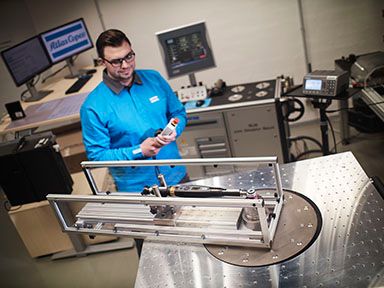
Our accredited calibration services provide you with:
- Measurement equipment calibration certificates following relevant standard
- Accredited lab and accredited on-site calibration services
- Functional test before calibration
- Calibration including adjustment where applicable
- Performed only with traceable reference equipment
- Calibration due-date reminders
- Retrievable calibration certificates for at least 10 years
Frequently Asked Questions about accredited calibration services
What are common quality assurance calibration standards?
ISO 6789 is an accredited calibration service standard for wrenches, covering electronic, dual, and click wrenches. EURAMET/cg-14 is currently the only widespread standard for accredited calibration of torque transducers used in quality control. Most markets apply national standards for accredited quality assurance calibration services based on this procedure. Also worth mentioning is VDI/VDE 2648 for angle calibration of quality assurance equipment; this standard is used globally due to the lack of international standards.
What are the key standards for calibration laboratories, and what does ISO/IEC 17025 cover?
When it comes to calibration, it is essential that your tools and measuring equipment are handled by qualified professionals. ISO/IEC 17025 is the international standard that defines the competence requirements for labs and field calibration providers. It is the key standard for becoming an accredited calibration service provider.
Many OEMs (Original Equipment Manufacturers) follow the automotive quality management standard IATF 16949 – International Automotive Task Force. This standard requires automotive suppliers to use calibration services performed by accredited labs, ensuring the highest quality and traceability in calibration.
What is the difference between factory and accredited calibration?
Only ISO/IEC 17025 accredited providers can perform accredited calibration services. This ensures that the measuring equipment is traceable to national standards and that measurement uncertainty is clearly documented. Accredited calibration services follow strict requirements for processes, systems, and technician competence, and are subject to regular independent audits.
In contrast, factory calibration is often conducted by non-accredited providers using simplified procedures. These calibrations may or may not include traceability of results and measurement uncertainty. Also, the procedure for calibration could deviate from recognized standards and procedures.
Downloads
- Quality Assurance Calibration Leaflet 339.7 kB, PDF
- Pocket Guide Calibration and testing of tightening systems 17.3 MB, PDF


- 2022 - Conformity check specification 3.1 MB, PDF
