
How to Choose an Inline Filter for Your Compressed Air System?
15 November, 2022
With an inline compressor filter, you can remove unwanted and harmful substances out of the air. Learn more here.

Compressed air quality is the measure of purity in a delivered air stream, defined by its concentrations of solid particulate, moisture and oil. Contaminated air damages equipment, disrupts processes and poses risks to product integrity in industries such as food and beverage, pharmaceutical and healthcare. ISO 8573-1 classifies this purity into defined classes, giving engineers and facility managers a precise framework for specifying, treating and verifying air quality across any industrial application. This guide covers how contaminants are classified, how ISO 8573-1 sets the quality standard, and what treatment and testing approaches are used to maintain air purity.
Contaminated air accelerates corrosion in pipework, valves and fittings, and causes premature wear in pneumatic tools and actuators. It is one of the leading causes of unplanned downtime in compressed air-dependent operations, with direct consequences for maintenance costs and production output.
In industries where compressed air contacts products directly or indirectly (food and beverage, pharmaceutical and electronics manufacturing) contaminants can cause product spoilage, failed quality audits or regulatory non-compliance. Instrument air used in control systems and pneumatic instrumentation is equally sensitive: moisture or particles in instrument air lines can cause measurement errors and valve failures. In medical applications, where compressed air is supplied directly to patients, purity must be guaranteed without exception.
Poorly treated air forces treatment equipment to work harder, increasing the risk of compressor faults and raising energy consumption and operating costs over time. Because the consequences of poor air quality vary by application, international standards exist to define precisely what "good" air quality means for each use case.
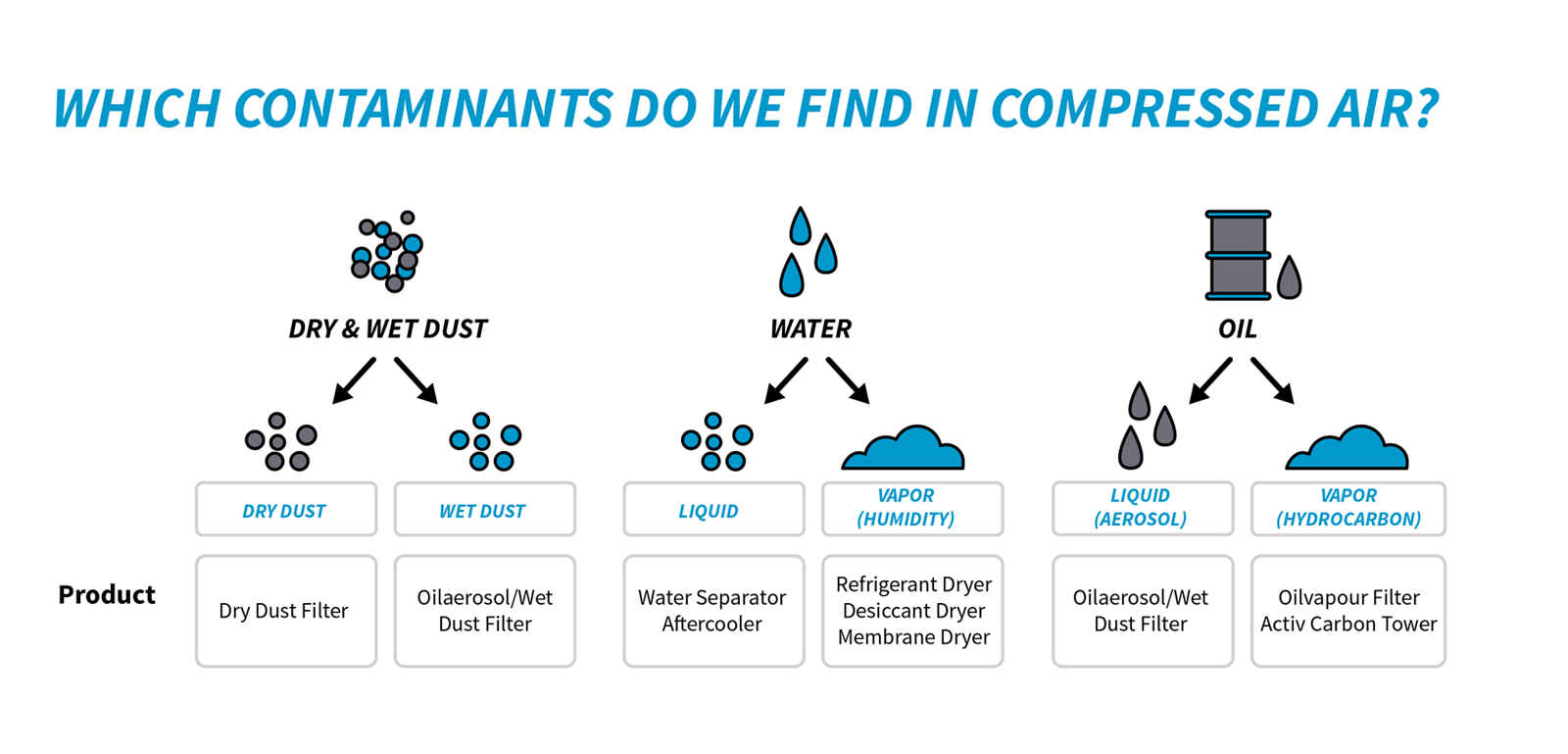
Dust, rust, pipe scale and atmospheric particulates enter the system through the compressor intake or are generated internally through pipe corrosion and component wear. They cause abrasive damage to pneumatic components and can contaminate sensitive end products. Particle sizes are measured in micrometres (μm) and concentrations in mg/m³.
Atmospheric air always contains water vapour, which increases in concentration under compression and condenses into liquid water. Moisture causes corrosion throughout the system, promotes microbial growth and creates problems in moisture-sensitive processes and instrumentation. The key moisture measurement is pressure dew point (PDP), expressed in °C. PDP determines whether moisture stays in vapour form or condenses in your system. See pressure dew point explained below.
Oil-lubricated compressors introduce oil aerosols and oil vapour into the compressed air stream. Even at very low concentrations (below 0.01 mg/m³) oil contamination is unacceptable in pharmaceutical, food and electronics manufacturing.
For a detailed breakdown of contaminant types, sources and their effects on compressed air systems, see our dedicated article on contaminants in compressed air.
The International Organisation for Standardisation has developed ISO 8573-1, the international standard for compressed air quality. It measures three contaminant types (solid particles, water and oil) and assigns a purity class based on the concentration of each found in the air stream.
Purity classes are expressed as a three-number notation, with one number per contaminant category. For example, a Class 1 rating for oil means the maximum total oil content permitted is 0.01 mg/m³. The lower the class number, the stricter the limit, so a system specified as Class 1.2.1 must meet Class 1 limits for particles, Class 2 for moisture and Class 1 for oil.
Class 0 represents the highest purity level, with limits more stringent than Class 1 defined by the equipment manufacturer or end user. It is typically required in critical applications such as medical air and semiconductor manufacturing. ISO 8573-1 does not cover microorganisms or gases.
Every purity specification is a set of three numbers, and the order is always the same: the first is for particles, the second for water, the third for oil. So a general manufacturing line running pneumatic tools is typically specified as ISO 8573-1 Class 1.4.1, particle Class 1, water Class 4, oil Class 1.
Only the middle digit separates that specification from [1:2:1], the class required for food, beverage and pharmaceutical air. Class 2 means a pressure dew point of −40 °C, which a refrigerant dryer cannot reach. The treatment train changes to a desiccant dryer. The same shift applies to any general-manufacturing line that runs outdoors or through an unheated bay, regardless of industry.
Use the table to locate your application, then read the class digit by digit as above.
| Application type | Typical ISO class requirement |
|---|---|
| Medical air | Class 0 |
| Pharmaceutical manufacturing | Class 1.2.1 |
| Food and beverage | Class 1.2.1 |
| Electronics manufacturing | Class 1.2.1 |
| Pneumatic instrumentation | Class 2.2.2 |
| General manufacturing | Class 3.4.3 |
| Pneumatic tools and machinery | Class 3.4.3 |
Filtration and drying are the two primary methods of treating compressed air. Each targets different contaminant types and the two are typically used together in sequence within a treatment system.
Compressed air filters remove solid particles, oil aerosols and water aerosols from the air stream. Oil and water in aerosol form are handled by coalescing filters, where liquid droplets merge, become heavier and sink to the bottom of the filter housing. Particulate filters capture solid particles including dust and pipe scale. For oil in vapour form, an activated carbon filter is required, as standard coalescing filters cannot remove vapour-phase contamination. All filtration causes a pressure drop, so filters should be correctly sized for the system flow rate and replaced on schedule to maintain efficiency.
Compressed air dryers remove moisture by reducing the pressure dew point of the air stream. Refrigerated dryers are used when a pressure dew point of around +3°C is sufficient, covering most general industrial applications. Where lower moisture levels are required, desiccant dryers achieve pressure dew points down to -40°C or -70°C, meeting the stricter moisture classes defined by ISO 8573-1.
PDP is the temperature at which water vapour in compressed air begins to condense at working pressure. It is not the same as atmospheric dew point: compression concentrates the water vapour the air carries, so the dew point at 7 bar(g) is significantly higher than that of the same air at atmospheric pressure. Any dryer specification, ISO 8573-1 water class or system comparison must reference PDP at actual line pressure, or the figures are not comparable.
Condensation occurs whenever any surface in the system falls below the pressure dew point of the air passing through it. The air itself does not need to cool. A cold section of pipework, an unheated warehouse bay, an outdoor run or a valve body in a chilled area is enough. The result is corrosion in the distribution network, damage to tools and instrumentation, product contamination and, below 0 °C, ice formation that blocks valves and control lines.
Set the pressure dew point at least 10 °C below the lowest temperature any part of the system will experience, including seasonal minimums and unheated sections. Not the average ambient temperature of the compressor room. That figure, matched against the ISO 8573-1 water classes, determines the dryer type.
PDP should be monitored, not assumed. A dew point sensor at the dryer outlet is the earliest indicator that a desiccant bed is saturating or a refrigerant dryer is losing capacity, usually well before moisture becomes visible downstream.
| Treatment type | Contaminant addressed | Typical performance |
|---|---|---|
| Coalescing filter | Oil aerosol, water aerosol | Oil removal down to 0.01 mg/m³ |
| Particulate filter | Solid particles | Filtration down to 0.1 μm |
| Activated carbon filter | Oil vapour | Oil vapour removal down to 0.003 mg/m³ |
| Refrigerated dryer | Moisture | Pressure dew point to +3°C |
| Desiccant dryer | Moisture | Pressure dew point to -40°C or -70°C |
Installing the right treatment equipment is the first step. But verifying that your system is actually delivering the required air quality at the point of use is equally important. Treatment equipment can degrade over time, and contaminants can be introduced downstream through ageing pipework, condensate accumulation or filter breakthrough.
Compressed air testing measures three key parameters: particle concentration (mg/m³ or particle count per m³), pressure dew point (°C) and total oil content (mg/m³). Sampling is carried out at the point of use rather than at the compressor outlet, to capture the true quality of air reaching your process or product.
Testing frequency depends on application criticality. Regulated industries such as pharmaceutical and food manufacturing typically require periodic testing as part of formal compliance programmes, while general industrial users may test following system changes or maintenance.
Our specialists can help you identify the right ISO 8573-1 class for your application and recommend an appropriate combination of treatment equipment for your system.
Compressed air quality refers to the level of purity of air delivered by a compressed air system, defined by the concentration of solid particles, moisture and oil present in the air stream. Quality is measured by counting particles of a specific size per cubic metre of air, measuring the pressure dew point in °C, and quantifying oil content in mg/m³. These three parameters form the basis of the ISO 8573-1 classification system.
The three main contaminant types are solid particles, moisture and oil. Solid particles include dust, rust and pipe scale, which cause abrasive damage to pneumatic components. Moisture enters as water vapour and condenses under compression, causing corrosion and microbial growth. Oil is introduced by oil-lubricated compressors in aerosol or vapour form, and even trace concentrations are unacceptable in sensitive industries such as food, pharmaceutical and electronics manufacturing.
ISO 8573-1 is the international standard for compressed air quality. It classifies air purity across three contaminant categories (solid particles, moisture and oil) using a three-number notation, with one number per category. The lower the class number, the stricter the purity limit. Class 0 represents the highest purity level, with limits more stringent than Class 1, and is required in critical applications such as medical air and semiconductor manufacturing.
Water classes 7 to 9 are defined by liquid water content instead, and apply where some free water is tolerated.
Pressure dew point is the temperature at which moisture in compressed air condenses at working pressure. Condensation is triggered by surface temperature, so if any point in the system drops below the PDP, water forms there. Relative humidity gives no usable threshold for a pressurised system. PDP does, and it is the parameter ISO 8573-1 uses to define water classes 1 to 6.
Compressed air quality is verified by sampling at the point of use and measuring three key parameters: particle concentration (mg/m³), pressure dew point (°C) and total oil content (mg/m³). Sampling at point of use is important because contaminants can be introduced downstream through ageing pipework, condensate accumulation or filter breakthrough. Testing frequency depends on application criticality, with regulated industries such as pharmaceutical and food manufacturing typically requiring periodic testing as part of compliance programmes.
Both are specified by the pressure dew point they achieve.
Refrigerated dryers cool the compressed air to condense and remove moisture, achieving pressure dew points around +3°C. They are suitable for most general industrial applications (Class 4 and above under ISO 8573-1).
Desiccant dryers use an absorbent material to achieve much lower pressure dew points, down to -40°C or -70°C, and are used where stricter moisture control is required. The right choice depends on the ISO 8573-1 moisture class your application demands.
The right ISO 8573-1 class depends on your industry, application and how sensitive your process or product is to contamination.
15 November, 2022
With an inline compressor filter, you can remove unwanted and harmful substances out of the air. Learn more here.
9 May, 2022
A number of decisions must be made when installing a compressed air system for it to provide the right air quality, since compressed air can contain some harmful contaminants like water vapor and oil.
13 November, 2022
Drying the output air is very important if you want to avoid problems in the compressed air system. Learn more about why drying is needed and how it is done.