



Quality Assurance in automated assembly lines
Stopping an automated assembly line is never a small decision.
Even accessing a tightening tool may require stopping production, opening safety guards, and following dedicated safety procedures. What was once a quick manual check can become a production disruption.
At the same time, the need for reliable tool performance has not changed — if anything, it has become even more critical.

Automation changes the rules of Quality Assurance
As automation increases, many traditional Quality Assurance approaches become harder to apply in daily production.
In automated applications:
- Accessing a tool may require stopping the entire production cell
- Manual checks can introduce unnecessary downtime and production interruptions
- Small tool deviations may affect large production volumes before detection
In this environment, Quality Assurance is no longer only a periodic quality activity. It becomes closely connected to uptime, process stability, and production continuity.
Automation is changing production — and Quality Assurance needs to change with it.

From manual checks to process-integrated Quality Assurance
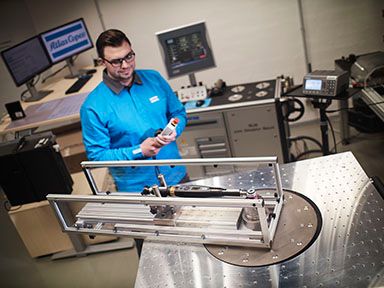
See automated tool testing in practice
Manufacturers need verification approaches that fit naturally into automated production environments — minimizing disruption while improving visibility into tool performance over time. This shift is changing the role of Quality Assurance from isolated manual verification toward more connected and process-integrated approaches.
To support this shift, Atlas Copco developed the Quality Integrated Ecosystem (QIE), helping manufacturers move toward smarter, process-integrated quality assurance in automated assembly lines.
Quality Integrated Ecosystem helps manufacturers:
vvvv
fvhfgfggujhy
This approach enables quality assurance to become more connected, scalable, and aligned with the realities of modern automated manufacturing.
Staying ahead in automated production
Modern manufacturing depends on more than production speed. It depends on maintaining confidence in the process.
As access to tools becomes more limited in automated environments, Quality Assurance can no longer rely only on manual checks and physical verification.
Today, Quality Assurance is no longer only about verifying tool accuracy. It is about maintaining confidence in the entire manufacturing process — while protecting uptime, safety, productivity, and product quality at scale.
This is the direction modern Quality Assurance is moving toward — and where Atlas Copco Quality Integrated Ecosystem is designed to support manufacturers.