

How to improve compressor efficiency and availability
20 February, 2026
Improving your air compressor’s efficiency is one of the most effective ways to reduce energy costs, avoid production downtime and extend equipment lifespan. Even if you invest in a premium compressor, its performance is heavily influenced by installation conditions, maintenance routines, and the right supporting equipment.
Checklist to increase air compressor efficiency
1. Correct installation
Installing your compressors in a clean environment with moderate temperature and moisture conditions is the first step to achieving optimal performance. Three components majorly contribute to efficiency for your compressor:
Air composition: A compressor sucks in the air around it. In a dusty environment, this means the inlet air filter will be saturated more quickly and will need to be replaced more frequently. If not, critical components of your compressor will suffer.
Temperature: The temperature of the air is directly proportional to the energy a compressor requires to compress. This means that cool air requires less energy and increases the overall air compressor efficiency.
- Humidity: Air compressors installed within humid environments generally tend to rust quicker and affect the overall compression. Ensure you install your air compressor in a dry-air environment to save your compressor from system and component damage.
2. Regular check-up of machine parameters
Following up on equipment parameters such as outlet temperatures and pressures gives the possibility to predict potential problems. This is possible if the data is collected and analyzed continuously. Take advantage of the remote connectivity features of your compressors.
Our standardized checklist for both oil-injected and oil-free air compressors includes essential maintenance procedures that can often be performed in-house or by a skilled technician. Key checks for the efficiency of the compressor include:
Service readings: Monitor air, oil, water, temperature, and pressure levels.
Leak detection: Check for any signs of air, water, and oil leakages.
Air intake inspection: Examine the air intake chamber for any obstructions or contaminants.
Filter assessment: Check all filters and filter elements for cleanliness and functionality.
Valve and switch adjustment: Ensure that all valves and switches are properly adjusted and functioning.
Connection integrity: Examine bolt and coupling connections and rubber inserts for wear or damage.
Fan and motor condition: Check the condition of all fans, air paths, motors, and drive gears.
Cooling system maintenance: Clean the cooling system and verify its correct operation.
Oil quality and level: Change the oil if necessary and check for the presence of water in the oil.
Electrical connections: Inspect for loose wiring and ensure all connections are secure.
Gearcase maintenance: Clean and inspect the gearcase for any issues.
Hose condition: Assess the condition of all hoses for any signs of wear or damage.
3. Proper maintenance plan
Following maintenance recommendations from the manufacturer is another key element. Having a recurring routine of parameters that you check for on a daily, weekly, or monthly basis will keep your machines operating at their best conditions. Here are a list of 8 maintenance tips to improve your air compressor efficiency:
Tighten all fasteners
Clean intake valves
Inspect the hoses
Drain the air receiver tank
Change the air filters
Change the lubricant
Change the separator elements
Cleaning the fuel tank
4. Proper selection of ancillaries
Consumption of air can be fluctuating which can result in a bad compressor operating mode and lower air quality. The impact can be reduced due to proper selection of ancillaries, such as dryers, air vessels, piping system and line filters.
Maintenance planning for optimal efficiency

A good maintenance plan makes the most of your investment and manages your resources effectively. You won't need to worry about parts inventory, equipment monitoring, service interventions and repairs.
If you are performing maintenance yourself, foresee efficient parts storage, the correct, certified tools and a trained maintenance crew. Although your in‑house maintenance team can typically handle most routine preventive tasks, certain jobs should always be carried out by a qualified compressed‑air professional. These include:
- Replacing motors
- Diagnosing and repairing mechanical failures
- Moving or relocating large or heavy compressor equipment
- Conducting system safety‑shutdown inspections
- Performing any compressor‑specific maintenance tasks for which your team has not been formally trained
Keep in mind that you will not be able to file a warranty claim in case of a breakdown resulting from incorrect service.
Advanced monitoring and control systems
Visual checks have their limitations, as a lot is happening on the inside of your compressor.
To get further assurance that your machines are running smoothly, follow up on equipment parameters such as outlet temperatures and pressures. If you notice that a parameter is out of the recommended range, contact your supplier as soon as possible.
Manual follow‑ups require logging every system parameter by hand, which is time‑consuming and prone to errors. A more efficient, user‑friendly approach is to leverage your compressor’s remote connectivity features. These digital monitoring tools give you deeper, real‑time insights into your compressed air system and provide actionable recommendations to improve performance and reduce energy consumption.
With SMARTLINK, you go beyond basic monitoring. SMARTLINK not only boosts system reliability through continuous performance tracking, but it also enhances energy efficiency by identifying optimization opportunities and suggesting improvements that help your compressor run at peak efficiency.
What can I expect from my equipment manufacturer?
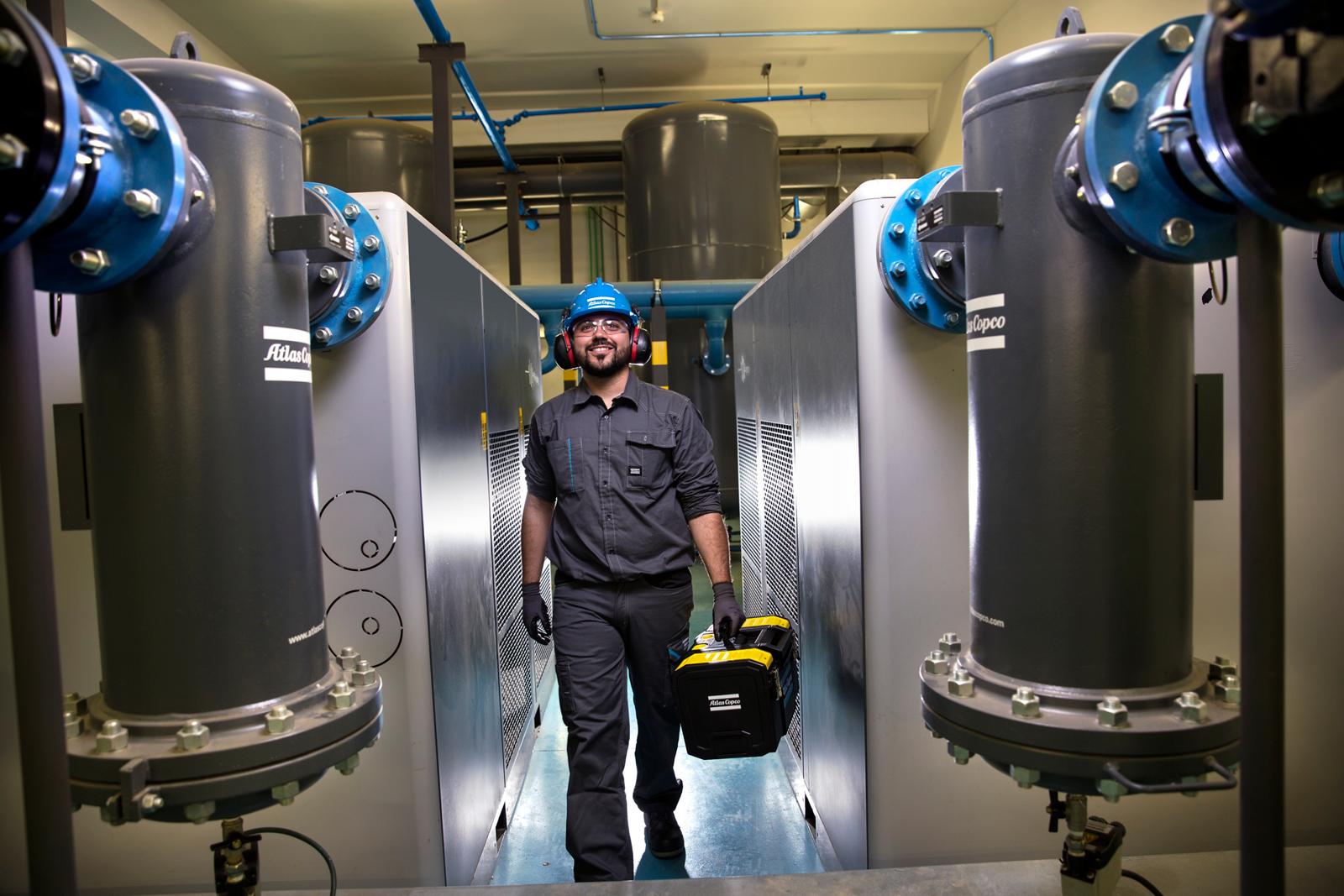
Leaving the care for your equipment in the hands of the manufacturer can save you a lot of time and effort. More importantly, it may be the shortest route to maximum air compressor efficiency and equipment availability.
Total Responsibility service plan is the best way to ensure the highest equipment uptime, and it can include the Availability Guarantee, our pledge that your equipment will be available for an agreed percentage of the time.
A promise we can make thanks to:
- SMARTLINK monitoring and remote diagnostic service
- The most efficient operational process
- The proper planning of regular maintenance and proactive extra jobs
Discover your potential savings and take the first step toward a more efficient compressor system
What causes air compressor inefficiency?
- Air Leaks: One of the biggest contributors to wasted compressor energy.
- Operating at Higher Pressure Than Necessary: Running a system at excessive pressure creates artificial demand, meaning end‑use equipment consumes more air than needed.
- Poor Maintenance: Improper or inconsistent maintenance leads to several efficiency‑reducing issues
- Environmental Conditions: Dirty, dusty, or poorly ventilated rooms.
- Lack of Monitoring: Without real‑time monitoring, small inefficiencies grow unnoticed.
- No central controller: Multiple compressors running without a central controller often compete or run inefficiently.
- Incorrect System Sizing or Changes in Demand: If your compressor installation doesn't match your production requirements.
How often should I perform compressor maintenance for optimal efficiency?
Follow the manufacturer schedule, adjusted for ambient conditions; plan interventions 2–3 months ahead to align parts, technicians, and production.
Safest way is to take a Total Responsibility service plan. For an all-inclusive price, Atlas Copco takes complete care of your compressor, with on-time maintenance by expert service engineers with genuine parts.
What is the difference between isentropic and isothermal efficiency?
- Isentropic efficiency tells you how good your compressor is compared to an ideal adiabatic compressor, where no heat is transferred during compression.
- Isothermal efficiency tells you how efficiently your compressor operates compared to the theoretical minimum work required under a perfectly constant‑temperature (isothermal) compression process.
Do air leaks have a big impact on the efficiency of my air compressor installation?
In older compressed air systems, up to 20% of total compressed air consumption can be lost through leaks. A leak of just 1/8 inch can result to nearly 42 000 kWh of wasted energy annually. Repairing compressed air leaks is a highly effective way to save energy.
What’s the single biggest factor in compressor lifecycle cost?
Energy consumption, which can represent up to 70% of lifecycle cost in a compressed air installation. This is why improving efficiency can deliver long-term savings.
FAQs
What is the efficiency factor of a compressor?
The efficiency of a compressor is the ratio of the compressed air output to the input power. Efficiency is calculated by dividing the useful output energy (compressed air) by the input energy (electrical power). In ideal conditions, the efficiency would be 1.0, but in reality, it's always less than 1.0.
Discover your efficiency potential
Speak with our compressed air specialists to develop a customized efficiency improvement plan tailored to your operations and budget.
Which compressor is best for industrial use?
For industrial use, rotary screw compressors are generally considered the best due to their durability, efficiency, and ability to provide continuous air supply. They are ideal for large-scale operations that require a steady and reliable airflow and can be tailored to specific requirements with various customization options.
Which compressor is more efficient and why?
Axial compressors are generally more efficient due to their design and operation principles. They handle higher flow rates and pressures with less energy loss, making them more efficient in terms of both energy consumption and airflow. Their efficiency comes from the aerodynamics of their blade design, which optimizes air flow and minimizes turbulence.


