
Optimization of Energy Consumption in Compressed Air Generation
April 21, 2025
Compressed air is indispensable for most manufacturing companies. However, their production is very energy-intensive and accounts for a large part of the total electricity bill for many companies. To keep costs as low as possible, you should conduct regular audits of the compressed air system and consider the use of energy-efficient compressor technology. In this article, we would like to introduce you to the biggest levers for reducing energy consumption in compressed air generation.

Energy Consumption in Compressors
If you add up all the costs over the entire life of a compressor, you will quickly realize that energy consumption accounts for most of the costs, whereas the acquisition costs and maintenance are often less than 20% of the total bill.
Regular maintenance and inspection can also have a positive effect on operating costs: Trained personnel can often see at first glance whether the running system still meets the energy standards and can advise on this.
After all, an investment in the latest compressor technology often pays for itself quickly. How quickly can be determined precisely with a consumption analysis and software-controlled simulation.
In the following section, we give you an overview of the current state of the art in the field of screw compressors:
Technological Innovations to Reduce Energy Consumption
Variable Speed Drive Compressors
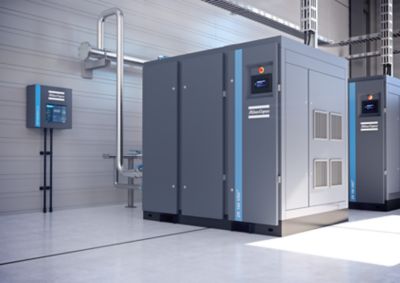
VSD compressors, also known as variable speed screw compressors, can adjust power consumption or energy consumption in real time to meet the current demand for compressed air. Fixed-speed models, on the other hand, only know the on or off state. This precise control greatly improves overall efficiency with fluctuating demand profiles.
Dual-Speed Compressors
Dual-speed compressors offer flexible operation with two speed settings that make it possible to significantly reduce energy consumption, especially during periods of lower load. This technology not only drastically reduces energy requirements during idle phases, but also optimizes the total cost of ownership through the more efficient use of energy.
Central Controller Systems
If you have several compressors in operation, you may want to think about a central controller system. These can integrate several compressors, even from different manufacturers, into a network and coordinate air production. These systems improve the performance and efficiency of the entire compressed air system.
Compressed Air Treatment
Compressed air treatment and filtration technologies ensure compressed air quality and protect your equipment and processes, as well as ensure product safety. This is essential to ensure high operational readiness and avoid damage caused by contamination or to comply with regulatory requirements for compressed air quality.
The use of energy-efficient compressed air dryers also makes a decisive contribution to a better energy balance and must not be ignored in the overall energy balance of compressed air generation. Here, too, it is worthwhile to regularly update yourself technologically and to regularly question the current state of the system.
How to Save Energy Costs on Existing Systems
In addition to investing in new, energy-efficient compressors, there are also many immediate measures that can help save energy in compressed air generation.
Permanent monitoring of compressed air generation and distribution can detect inefficiencies, such as leaks, so that countermeasures can be initiated at an early stage.
Not to forget the use of high-quality spare and maintenance parts, such as the inspection of the system by trained compressed air experts, contribute to fault prevention and optimal energetic operation.
Data-driven tools and monitoring systems also offer valuable insights into operational processes and help to minimize energy consumption.
Heat Recovery
Since a compressed air system generates a lot of waste heat, you should have it checked whether a heat recovery system makes sense for you.
Classic heat recovery systems use waste heat from compressors to heat rooms or provide hot water.
This allows up to 75% of the waste heat to be reused. In combination with a heat storage system, the energy recovered in this way can even be stored for up to 24 hours before it is fed into its intended use.
Another way to reuse energy is to use high-temperature heat pumps, which can bring compressor waste heat to an even higher temperature level. This means that it can also be used in a very energy-efficient way for other industrial processes. With heat pumps specially adapted to compressors, the energy can be reused almost completely.
Leak Detection
Leaks in the compressed air system can cause significant energy losses. These losses can be minimized by using ultrasonic measurement technology for leak detection. A professional leak detection usually takes one to two days and pays for itself very quickly.
The early detection and elimination of leaks reliably helps to reduce the energy consumption of the compressed air station and maximize efficiency accordingly. More about leak detection.
Smart Monitoring Systems
Modern smart monitoring systems, such as our SMARTLINK solution, provide real-time monitoring of air compressors. They provide timely information about upcoming maintenance and possible problems, which minimizes downtime and increases efficiency. These systems enable continuous optimization and help reduce operating costs.
Reducing Energy Consumption in Compressed Air Systems Pays Off
Optimizing energy consumption in compressed air systems is crucial to reduce operating costs and reduce environmental impact. By using modern technologies and practical measures, companies can significantly increase their energy efficiency. The support of experts and the use of government subsidy programs also help to ensure that energy-saving measures can be implemented effectively.
An important step in identifying potential savings is to carry out a compressed air energy measurement. This makes it possible to collect precise data on current consumption and to develop targeted measures to increase efficiency. More about compressed air measurement.


