

When you walk into a modern furniture plant, what you see is just the surface. Conveyor lines humming. Robotic arms folding and sealing. Panels moving in perfect sync. What you don’t see — but what keeps the entire process alive — is compressed air.
From edge banding to automated packaging, compressed air systems are the invisible infrastructure behind high-speed, high-precision production. They deliver the force, control, and reliability that today’s furniture manufacturing demands.
In a world where margins are tight and output expectations keep rising, compressed air isn’t a luxury — it’s a critical utility. And for factories scaling up automation, it’s one of the smartest systems to optimize.
Why compressed air matters more than ever
In today’s manufacturing landscape, speed, precision, and uptime aren’t just benchmarks — they’re business-critical. Compressed air systems meet all three head-on, making them indispensable across modern production environments.
Unlike traditional power sources, compressed air is clean, scalable, and adaptable. It doesn’t produce sparks, making it safer in dusty or flammable environments. It also works seamlessly with a wide range of pneumatic tools, actuators, and robotic systems that handle everything from light positioning to heavy lifting.
For furniture manufacturers, compressed air enables:
- Consistent actuation across multiple lines — from wrapping to drilling
- Instant, controllable force — critical for precision operations like edge banding
- Non-stop flow — ideal for 24/7 plants that can’t afford downtime
More importantly, it scales with your operation. With the right setup — such as variable speed compressors (VSD) — air delivery adjusts in real time based on demand. That means no energy waste, no lag, and maximum performance per kilowatt.
Bottom line? Compressed air isn’t just part of the system. It is the system.
Inside the factory: Where compressed air gets to work
Compressed air systems aren’t limited to a single station or task — they run throughout the production line like a hidden nervous system. Let’s map out exactly where they make an impact in a modern furniture plant.

Wrapping and in-feed systems
Compressed air powers ejectors that precisely position particle boards before they're wrapped in paper foil. The accuracy here is critical — one misalignment and the entire flow gets disrupted.
Edge banding and drilling
Air jets clean holes and surfaces before glue is applied. Pneumatic clamps stabilize panels during drilling. In some setups, compressed air also drives cutter motion.
Robotic packaging
Vacuum grippers, folding arms, and box-sealing mechanisms all rely on regulated airflow. These air-powered tools operate faster and more reliably than many mechanical systems.
Material handling and transport
Compressed air supports vacuum systems and pneumatic conveyors used to move glue granules, edge band, foil, and similar inputs — especially in automated, high-throughput facilities.
Across these steps, compressed air does more than assist — it enables automation.
The machines behind the scenes
Compressed air performance starts with the right equipment. In high-demand environments like furniture manufacturing, efficiency, uptime, and precision all depend on well-designed systems.
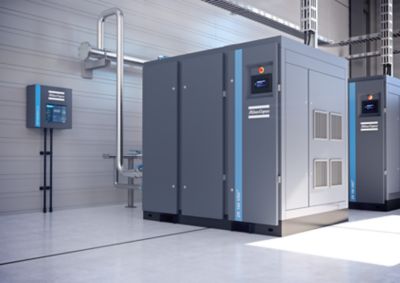
Variable speed drive compressors (VSD)
VSD units adjust air output based on real-time demand. This dramatically reduces energy waste and mechanical wear.
- Up to 35% energy savings vs. fixed-speed
- Stable pressure even during peak loads
- Reduced noise and longer compressor lifespan
Dryers and filters
Moisture and particles can damage pneumatic tools. Integrated dryers remove humidity, while multi-stage filters catch oil and dust before they hit the line.
Localized air units
For tools requiring specific flow rates or pressure levels, localized compressors or regulators deliver precision where it’s needed — reducing drop-offs across the system.
These elements form a smart, responsive compressed air network optimized for non-stop manufacturing.
Efficiency, uptime, and precision: What’s at stake
Compressed air is often one of the highest operating costs in a plant — but it’s also one of the easiest to optimize. And doing so has real, measurable benefits.
Lower energy consumption
With smart controls, leak detection, and VSD technology, plants can cut compressed air energy usage by 20–30% or more.
Better product quality
From perfect drilling depth to reliable panel placement, consistent airflow supports tighter tolerances and fewer defects.
Maximum uptime
Modern compressed air systems come with predictive maintenance tools, diagnostics, and centralized control — all helping to eliminate unplanned stoppages.
For manufacturers under pressure to deliver more with less, compressed air efficiency is a competitive advantage — not just a cost center.
Compressed air equals smart production
Furniture manufacturing is evolving — faster lines, smarter systems, higher expectations. And behind the scenes, compressed air is making it all possible.
It powers key production phases, keeps automation running smoothly, and plays a direct role in reducing downtime and energy waste.
Whether you're scaling up or fine-tuning existing lines, compressed air should be at the center of your optimization strategy.
If your plant isn’t treating compressed air as a strategic asset, it’s time to rethink your utility game.


