
September 19, 2025
Estimated reading time: 5 minutes
What is a nitrogen generator?

A nitrogen generator is an industrial system that produces nitrogen gas on-site by separating it from the surrounding air. Ordinary air is about 78% nitrogen and 21% oxygen, with small amounts of other gases. While nitrogen is abundant in the atmosphere, it cannot always be used directly in industry because most processes require gas of higher purity or in controlled flow and pressure.
Nitrogen generators perform this task by filtering compressed air and isolating nitrogen molecules from oxygen, carbon dioxide, and water vapour. The result is a steady supply of purified nitrogen gas available for industrial use. In practical terms, this means companies no longer need to depend on delivered cylinders or bulk storage tanks, which can be costly and logistically restrictive.
Nitrogen generator function: the primary function of a nitrogen generator is to provide a continuous, reliable, and on-demand source of nitrogen tailored to the required purity level. This makes it essential for industries where oxidation must be controlled or prevented, such as:
- Electronics manufacturing: preventing corrosion of circuit boards.
- Food and beverage industry: extending shelf life by reducing oxygen exposure.
- Automotive and tyre inflation: improving stability and safety.
- Chemical processing: providing an inert atmosphere to prevent unwanted reactions.
By generating nitrogen in-house, businesses gain more independence and flexibility, while avoiding regular deliveries and handling of high-pressure gas cylinders.
How does a nitrogen generator work?
A nitrogen generator works by separating nitrogen molecules from oxygen and other gases in compressed air, producing a controlled stream of nitrogen gas. This process is known as nitrogen gas production and can be achieved through different nitrogen production methods.
To generate nitrogen from air, the generator first receives a flow of clean, dry compressed air. Inside the unit, a separation technology isolates nitrogen molecules, while oxygen, carbon dioxide, and water vapour are removed. The result is a purified nitrogen output that can be used immediately or stored for later use.
Two main technologies are used in modern nitrogen generation systems:
Membrane nitrogen generators – compact units that separate gases using semipermeable fibres.
Pressure Swing Adsorption (PSA) nitrogen generators – systems that use carbon molecular sieves to achieve very high nitrogen purity.
The choice between these depends on the required nitrogen quality and application. For example, inflating tyres or fire suppression may only require 90–99% purity, where a membrane unit is sufficient. In contrast, industries such as food packaging or plastics often need purities up to 99.999%, which can only be achieved with PSA technology.
Nitrogen generation system
A nitrogen generation system is the complete installation required to produce, store, and distribute nitrogen on-site. While the generator is the central component, several other elements work together to ensure stable operation and gas quality.
A standard nitrogen production plant consists of:
- Air compressor: supplies the compressed air.
- Dryer: removes moisture from the air.
- Filters: capture oil vapour and solid particles.
- Air receiver: stabilises pressure and flow.
- Nitrogen generator: separates nitrogen from oxygen and trace gases.
- Nitrogen receiver: stores produced nitrogen for peak demand.
Nitrogen can either be consumed directly from the generator outlet or buffered in a storage tank for continuous supply.
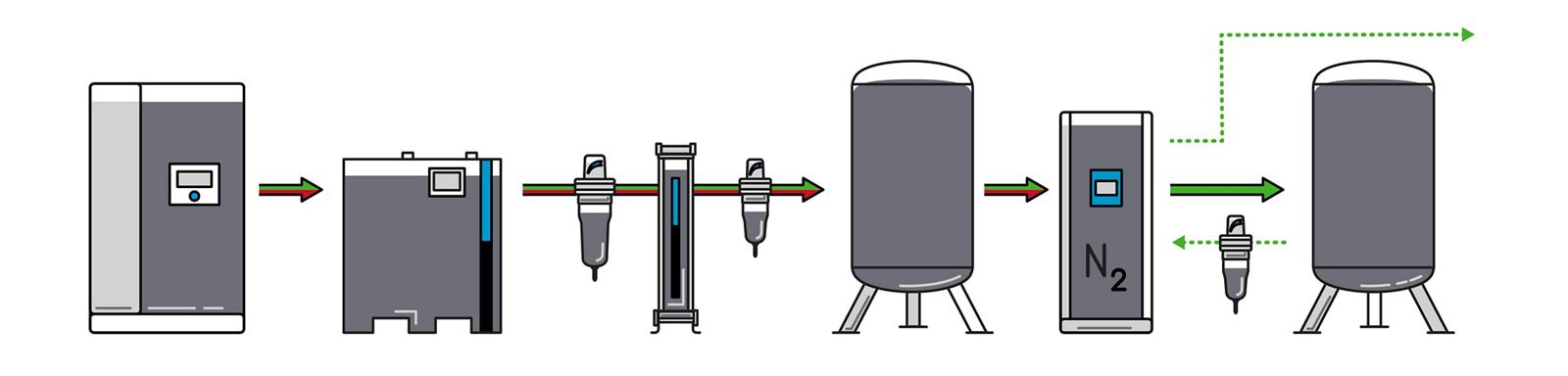
Typical layout of a nitrogen generator installation
Membrane nitrogen generators

This technology separates air into component gases by passing inexpensive compressed air through semipermeable membranes consisting of bundles of individual hollow fibers. Each fiber is very small, has a perfectly circular cross-section and a uniform bore through its center. At one end of the module, compressed air is introduced into the fibers and contacts the membrane as it flows through the fiber bores. Oxygen, water vapour and other trace gases easily permeate the membrane fiber and are discharged, but nitrogen is contained within the membrane and flows through the outlet port. Because water vapour permeates through the membrane, the nitrogen gas stream is very dry, with dewpoints as low as -50°C (-58°F).
Membrane technology is simple and efficient, with compact, all-in-one units that require little maintenance and have zero operational costs. It’s ideal for applications where the required flow of nitrogen is relatively low and purity levels do not exceed 99%. Membrane technology has a lower initial investment than high flow/high purity technologies such as Pressure Swing Adsorption (PSA).
Pressure Swing Adsorption (PSA) nitrogen generators
Adsorption is the process in which atoms, ions or molecules from a substance (compressed air in this case) adhere to a surface of an adsorbent.
A PSA generator isolates nitrogen, and the other gases in the compressed air stream (oxygen, CO2 and water vapour) are adsorbed, leaving behind essentially pure nitrogen.
PSA traps oxygen from the compressed air stream when molecules bind themselves to a carbon molecular sieve. This happens in two separate pressure vessels (tower A and tower B), each filled with a carbon molecular sieve, that switch between a separation process and a regeneration process.
Clean and dry compressed air enters tower A. Since oxygen molecules are smaller than nitrogen molecules, they pass through the pores of the sieve. Nitrogen molecules cannot fit through the pores, so they bypass the sieve resulting in nitrogen of desired purity. This phase is called the adsorption or separation phase. Most of the nitrogen produced in tower A exits the system, ready for direct use or storage.
Next, a small portion of the generated nitrogen is flowed into tower B in the opposite direction. This flow pushes out the oxygen that was captured in the previous adsorption phase of tower B. By releasing the pressure in tower B, the carbon molecular sieves lose their ability to hold the oxygen molecules, which detach from the sieves and get carried away by the small nitrogen flow coming from tower A. This ‘cleaning’ process makes room for new oxygen molecules to attach to the sieves in a next adsorption phase.
PSA technology enables continuous, high-capacity nitrogen flow in demanding applications at purity levels up to 99.999%. PSA generators have a higher initial investment cost than membrane generators, but they offer the advantages of higher flow and higher purity levels that some industries and applications demand.
PSA vs. membrane generators
PSA units deliver ultra-high purity but are more complex, while membrane systems are simpler and more robust. In both cases, nitrogen generator maintenance is essential for consistent performance.
|
PSA |
MEMBRANE |
ACHIEVABLE PURITY |
EFFICIENTLY UP TO 99.999% |
EFFICIENTLY UP TO 99.9% |
EFFICIENCY |
HIGHER |
HIGH |
PERFORMANCE VS. TEMP. |
LOWER AT HIGH TEMP. |
HIGHER AT HIGH TEMP. |
SYSTEM COMPLEXITY |
MEDIUM |
LOW |
SERVICE INTENSITY |
LOW |
VERY LOW |
PRESSURE STABILITY |
FLUCTUATING IN/OUTLET |
STABLE |
FLOW STABILITY |
FLUCTUATING IN/OUTLET |
STABLE |
START-UP SPEED |
MINUTES/HOURS |
SECONDS |
WATER (VAPOUR) SENSITIVITY |
PDP MAX 8°C |
NO LIQUID WATER |
OIL SENSITIVITY |
NOT ALLOWED (< 0,01mg/m³) |
NOT ALLOWED (< 0,01mg/m³) |
NOISE LEVEL |
HIGH (blow-off peaks) |
VERY LOW |
WEIGHT |
MEDIUM |
LOW |
Membrane systems typically require less service, as they have no moving parts and fewer sensitive components - this makes them well-suited for environments where downtime must be avoided.
PSA systems require more attention to intake air quality, filters, and adsorption media, but when paired with a structured nitrogen generator maintenance schedule, they deliver the highest levels of purity and performance for demanding applications.
Industrial applications of nitrogen generators
Nitrogen is widely applied in industry because it is inert, odourless, and prevents oxidation. An on-site generator supplies nitrogen at the right purity and flow, reducing reliance on bottled deliveries while ensuring a stable gas supply.
Key applications include:
- Chemical processing: nitrogen is used to create inert conditions that prevent explosions or unwanted reactions. A nitrogen generator in the chemical industry allows operators to maintain safety while reducing gas procurement costs.
- Food and beverage production: controlled atmospheres help extend shelf life and preserve flavour. In packaging lines, a nitrogen generator for the food industry flushes oxygen from packets, while in a beverage factory, nitrogen protects liquids during bottling and storage.
- Automotive sector: nitrogen-filled tyres maintain pressure for longer and reduce oxidation of the rubber. Using a nitrogen generator for tires ensures a reliable supply for service centres and fleet operators.
In short, when asking "What is a nitrogen generator used for?", the answer covers a wide spectrum, from laboratories and plastics to aquaculture and pharmaceuticals, anywhere an oxygen-free or low-oxygen environment is required.
Advantages of on-site nitrogen generation
Producing nitrogen in-house gives companies direct control over output, purity, and pressure. Beyond flexibility, there are significant operational and financial advantages compared to relying on external suppliers.
Key benefits include:
- Cost stability: independence from market price fluctuations for bottled or bulk nitrogen.
- Lower logistics costs: no transport fees, delivery scheduling, or return handling of cylinders.
- Safety improvements: eliminates the risks of storing and handling high-pressure bottles.
- No waste: avoids boil-off losses from liquid tanks and unused residual gas in cylinders.
- Reliability: continuous supply available around the clock, reducing risk of production downtime.
- Long-term savings: while the equipment requires upfront investment, operating costs are significantly lower over time.
These factors make on-site nitrogen generation not only a technical solution but also a way to improve safety, efficiency, and cost management in daily operations. Read more about the benefits of onsite nitrogen generation.
Choosing the right nitrogen generator
Every application has different needs when it comes to nitrogen flow, purity, and operating conditions. The right system ensures efficiency, safety, and long-term cost savings. For some industries, a compact membrane generator may be sufficient, while others require the ultra-high purity delivered by PSA technology.
Because the choice depends on both technical and economic factors, it is often best to review requirements with a specialist who can match the system to the process.
Ask an air system professional about the best solution for generating nitrogen in-house.
Frequently asked questions
What is a nitrogen generator used for?
A nitrogen generator is used to provide a continuous supply of nitrogen gas for industrial processes. Applications include food packaging, beverage bottling, tyre inflation, chemical processing, electronics manufacturing, and laboratory work.
Do nitrogen generators need compressed air?
Yes. All nitrogen generators rely on compressed air as their source. The air is filtered, dried, and then processed inside the generator, where nitrogen is separated from oxygen and other gases.
How is nitrogen made industrially?
Industrial nitrogen is commonly produced using cryogenic distillation or on-site nitrogen generators. Cryogenic plants separate gases at very low temperatures, while generators such as PSA and membrane units separate nitrogen directly from compressed air.
What are the different types of nitrogen generation?
The two main types are:
- Membrane generators – compact, low-maintenance units for moderate purity needs.
- Pressure Swing Adsorption (PSA) generators – larger systems capable of delivering high to ultra-high purity nitrogen.
Related topics


Air and gas treatment Compressor Technique NGM⁺ Air compressors Nitrogen generation systems Nitrogen and oxygen generation systems NGM Cluster tons
