





The pressure to boost production while keeping costs low is essential for success in today’s fast-paced manufacturing world. As companies are encouraged to develop more efficient workflows, automation delivers the results they seek. While large-scale automation projects can produce impressive outcomes, manufacturers that take on these solutions must navigate major assembly disruptions and lengthy timelines.
In this success story, we will highlight the advantages of a targeted, agile automation solution that can help manufacturers achieve significant productivity gains quickly and cost-effectively, all while avoiding the disruption of a full-scale overhaul. Read on to discover how we were able to transform their assembly without the hassle that comes with larger-scale automation projects.
Finding the balance: Should you invest in large- or small-scale automation projects?
Both large- and small-scale automation projects have their advantages and disadvantages. The key differences depend on your assembly requirements.
Let us first begin with large-scale automation projects, which cover entire production lines or facilities. Large-scale automations tend to be more complex, involving multiple integrated systems, a larger investment in terms of cost and implementation time, and requiring dedicated teams and resources to maintain and support. Large-scale automation is most beneficial when you’re under redesign or significantly scaling up production.

On the other hand, small-scale automation projects, as the name suggests, are smaller overall, targeting specific tasks or process steps. Unlike large-scale automation, small-scale automation typically consists of standalone systems, which require a smaller overall investment cost, shorter implementation time, and can often be handled by existing staff. In this way, small-scale automation is most beneficial when you need a quick turnaround, are just starting with automation, or need a more cost-effective solution.
Still unsure if automation is essential for modern assembly operations? Join our webinar, Why automate? Smarter assembly for a competitive edge, to uncover the benefits of automation.
From customer challenges to integrated solutions
In this specific case, our customer needed to enhance a housing sub-assembly process to meet demanding production targets; however, investing in a complex, high-risk automation project that would halt operations was not the answer. Rather than seeking a large-scale solution, the team sought a smarter approach: one that was simple to implement and could be integrated directly into the existing production line. The objective: get the job done faster, more efficiently, and with less hassle.
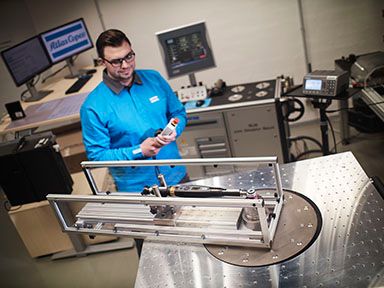
With this in mind, our experts were able to propose a practical solution, a Smart Integrated Assembly system built around a single unit. At its core is a single spindle cobot with a tightening system that comprises:
- A Power Focus controller, which is a controller platform for your battery, cable, and fixtured tools
- An automatic screw presenter
- And the STRwrench, our smart torque wrench that provides the best experience possible for static and residual torque verification
all mounted on a simple table and complemented by floor scanners. This setup also includes ToolsNet 8, which allows data collection throughout the assembly process.

Unlike a large-scale automation solution that would be costly in both time and profits while halting production, this system acts as a streamlined approach, ensuring the integration is compact and quick while still allowing the original manual line to remain in place as a reliable backup. With this solution, we were able to offer a low-risk strategy that maintained operational flexibility and gave the team peace of mind.
A rapid return through smart automation
Before implementing this solution, the application required six operators to complete and experienced frequent production downtime due to outdated equipment, resulting in a total annual cost of $210,000.
Thankfully, with help from our experts, the project delivered immediate and measurable success:
- Increased productivity: The new system achieved the 30-second cycle time requirement, allowing the plant to meet its production goal.
- Operational efficiency: The implementation allowed them to reallocate operators to more complex assembly tasks.
- Rapid payback: With an investment of $184,335.62, the system generated projected annual savings of $210,000. This resulted in an incredibly fast payback period of just 10.53 months.
Meeting application needs and strict requirements
With a limited budget, space, and a tight cycle time of 30 seconds, our experts were able to meet and exceed our customer’s goals. With the small-scale automation solution in place, our customer could optimize assembly, enabling them to reduce downtime and improve quality.
Are measurable results something you’re looking for? Perhaps an automated solution is right for you. Contact our experts today to discover our offering.
